History of Arsenal do Alfeite


  • Hydrographic Ship “D. João de Castro” in Ship-way
  • Yacht “Donapila II”
  • Hull cleaning of a submarine in Dry Dock
  • Refrigerated Cargo Ship
  • Patrol Vessel for the Republic of Guinea-Bissau
  • “Creoula” in Dry Dock
  • Insignia of Honorary Member of the Agricultural and Industrial Order
  • Insignia and Gold Medal – the highest municipal distinction

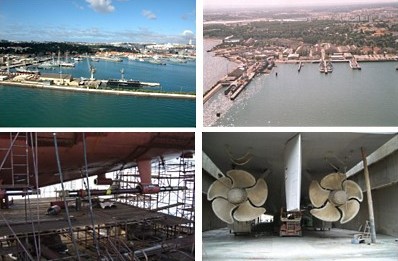
Arsenal do Alfeite´s construction, begun in 1928 and, funded by the World War 1 German indemnity received after the signing of the Versailles Treaty, was completed in December 1937. Although it became operational in 1938, it was only officially inaugurated on 3 May 1939. Arsenal do Alfeite (AA) was created by Act no. 28 408 of 31 December 1937 and was considered one of the largest and best-equipped institutions of it kind.
Arsenal do Alfeite began its operations with the repair of two Navy Destroyers, the torpedo ships ´´Dão´´ and ´´Tâmega´´ - the latter being the first ship to dock at this shipyard. Simultaneously, the construction of naval vessels began - the first being the Hydrographic Ship ´´D. João de Castro´´. Thus was the activity of the shipyard initiated, making it for many decades a national and international reference not only in the construction, repair and maintenance of military ships but also in the building of merchant ships of all sizes.
The three decades that followed were characterized by a relatively large degree of autonomy in terms of management which made possible the construction of various military and non-military ships, culminating in the building of the ´´Gerês´´, an oil-tanker measuring 191,7 m in length and weighing  35 625 tonnes -  making it the largest ship built at AA to date.  During this period, AA also built ships for foreign Ship-owners: the fishing trawlers, ´´Portisham´´ and ´´Portaferry´´ for the United Kingdom, the oil-tanker (hull) ´´Hector´´ for Sweden, and, for Liechtenstein, the yacht ´´Donapila II´´ with a length overall 49.99 m, beam 7.32 m, draft 3.66m and displacement 254 tonnes, was entirely Portuguese project, designed by the Naval Architect Jorge d´Almeida Araujo.
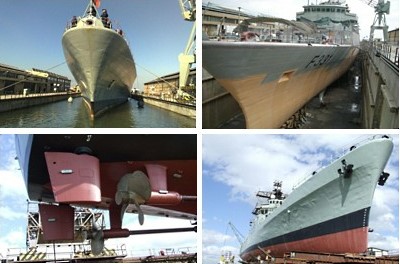
From 1970 onwards, several improvements were made to the Shipyard thereby increasing its operational capabilities, namely the construction of a Dry Dock and a Floating Dock. The latter, built at AA, was destined mainly to dock and repair the Navy´s submarines of the class ´´Albacora´´. To carry out the repair and maintenance of these submarines, AA sent technicians to France for highly specialized training, marking the beginning of a new service provided called the IRS (Inspection of the Repairs of Submarines). And so, in the 70´s and 80´s, the increased docking capacity allowed the Shipyard to carry out major revisions of frigates and submarines, expanding its maintenance of Navy ships. The modernization of the School-ship ´´Sagres´´ in 1988 is noteworthy due to its importance.
Within these two decades, the Shipyard carried out some great naval construction jobs. This began in the early 70´s when the Buoy Tender Vessel, the ´´Shultz Xavier´´, was built. Later on, because of the political situation brought on by 25 April 1974, the Shipyard expanded its market, building two large Refrigerated Cargo Ships – the ´´Dzieci-Polskie´´ and the ´´Zyrardów´´ for Poland. This was followed by a Great Landing Craft (GLC); several Medium Landing Craft (MLC´s); an ´´Oceanic Research Ship´´; several Passenger Vessels; two Lifeguard Boats; Inspection  Boats of the class ´´Albatroz´´ and two Hydrographic Ships, the ´´Andromeda´´ and ´´Auriga´´.


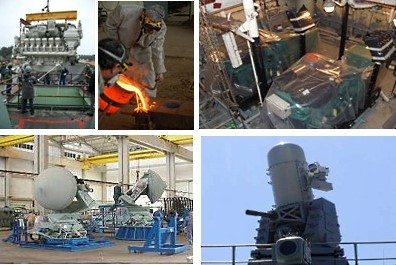
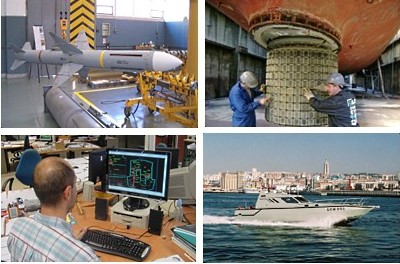
Between 1990 and current times, the Shipyard has been restructured on several occasions, the most important changes being those that created new areas and capabilities such as: the integration into the AA, the Weaponry and Electronics Workshops, the creation and accreditation of laboratories and even at the production management level – the improvement noted with the implementation, in 1994, of SIAGIP (The Integrated Computer System for the Management and Support of Production). On the other hand, the significant and progressive decline in the number of workers, already begun in the previous decade, continued. In the 90´s, in accordance with the Navy´s interests, the AA insured the specialization of workers both in Portugal and abroad, particularly in the areas of mechanics, electricity, electronics and weaponry, thus enabling  the maintenance of Frigates of the class ´´Vasco da Gama´´.
Parallel to conducting major repair work for the Navy, the Shipyard continued to be at the forefront of national naval construction with its own technologically innovative projects; this included some hi-tech prototypes never designed in Portugal before. Examples include: the construction of Coastal Patrol Vessels of the class ´´Argos´´, made of plastic reinforced with fibreglass (PRFG) and equipped with an innovative launching and retrieval system of its semi-rigid boat while in motion; Patrol Vessel propelled by hydro-jets for the Republic of Guinea-Bissau – a project which combined PRFG with aluminium; Coastal Patrol Boat in naval aluminium of the class ´´Centaur´´; two Fast Patrol Boat of the class ´´Bolina´´, manufactured and designed via the computer-aided programme CAD/CAM; and three self-righting Lifeboat for ISN, with ´´nautical stability´´.
In the mid 90´s, after exhaustive historical research and external consultation, AA was largely responsible for the reconstruction and fitting out of the 19th century War Frigate, ´´D. Fernando e Gloria´´, put  on exhibition at EXPO ´98.
Throughout its long existence, AA has not only worked on its own projects but also done work for other entities, such as for The Portuguese Naval and Metal Mechanic industries for which it manufactured large structures. This includes: the building of blocks and shaping of metal sheets for super tankers for Lisnave in Margueira as well as for ships built in Viana do Castelo; the building of some parts of cranes and gantries of ´´Setenave´´ in Mitrena; etc.
Over the last seventy years, Arsenal do Alfeite has practically been a ´´school´´ of Naval Industry and metalworking – its contribution to and influence in these industries, provided by AA´s specialized workers, has been so extensive that it can hardly be evaluated. One example would be the presence, lasting for several years in the 1960s and 70s, of a team of Arsenal do Alfeite master craftsmen in the Viana do Castelo Shipyard with the aim of training that Shipyard in the technique of building ships in blocks. A further example would be the training given in the Lisnave training schools by technicians formerly of the AA; or the presence of many professionals of diverse technological fields in the greater metropolitan area of Lisbon whose knowledge and skills were either acquired in the Arsenal do Alfeite workshops or in its Training School, created in the early 1970s.
In 1990 the then State President, Mario Soares, awarded AA the Insignia of Honorary Member of the Agricultural and Industrial Order as part of the shipyard´s 50th Anniversary Celebration.

In 2007 the Almada City Hall awarded AA this city´s Insignia and Gold Medal – the highest municipal distinction.

After seven decades of activity, the Defense Minister decreed, through Law nº 33/2009 of February 5, the end of Arsenal do Alfeite and, with a view to turning it more into a business , formed ´´Arsenal do Alfeite, S.A.´´, a Limited Company exclusively financed  by public funds, part of the naval cluster EMPORDEF, SGPS S.A., a  holding of the Portuguese Defense Industries, whose job it is to manage state-owned shareholdings in companies linked directly or indirectly to the activities of defence as an indirect way of engaging in economic activities.
Arsenal do Alfeite S.A. became operational on September 1, 2009, driven by the need to become a national and international reference entity in the marine industry, a need imposed by the technological development in this sector.